Tuesday, 23 March 2010

The Journey Home

After 5 days of false starts due to bad weather it was time to go. The waiting to leave was a weird time, constantly shifting between periods of intense activity and anti-climax as the transfer was posponed yet again. It also made cooking difficult to manage...I am not sure how many times the meat was taken out and then placed back into the freezer!.

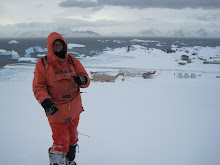
When it did happen...it happened fast. All the luggage was thrown onto sledges and we were whizzed down to the sea ice where The Shackleton and the James Clark Ross took it in turns to shelter each other from the swell as each boat was loaded by putting their bows into the sea ice. I think getting up the gangplank on the Shak was probably the scariest experience of the trip. The sway was extreme and I couldn't keep my footing as it was so slippery. I thought I was going to end up in the water that lay between the boat and the ice before being grabbed by the scruff of my neck and hauled aboard! As you can see, John (beardless!) after 18 months on the ice, was keen to celebrate!


It was nerve wracking at first hearing the boat moving through the ice - it sounded like several million tin cans being crushed simultaneously. On the thicker parts of the ice the boat rose out of the water at the front to crash down on top of the ice to break it.

It was also amazing to watch how delicately this load of steel could maneouver through the ice, using its sideways thrusters to move away from iceburgs and find the easiest passage through the sea-ice.
 
I don't remember much more of the sea journey as I suffered six days of chronic sea-sickness...alternating between getting slammed against the wall in my bunk and waiting...anxiously...as the boat rose to the top of the crests of the waves...wondering if it was ever coming down again....the notorious Shackleton 'corkscrew' effect! Suzanna the Doc, kept me alive with frequent cups of tea!
 
Arriving at the Falklands it seems that history is everywhere. Shipwrecks litter the coastline. Passing Goose Green were the remains of the Vicar of Bray (above), one of the last Californian gold rush ships, rotting away by a jetty. On Stanley’s waterfront was the mizzen mast of Isambard Kingdom Brunel’s SS Great Britain.
 
Getting my landlegs back after spinning like a top for so long was a huge relief and I took the 4 days we had there as a chance to explore the main town a bit.
 
This distant relic of the British Empire has extraordinary wildlife, breathtaking scenery, historical relics and 700,000 penguins, 600,000 sheep (allegedly....I didn't see one) and 3,000 human beings in an area half the size of Wales. Cruise ship day-trippers excepted, this archipelago of 740 islands off the tip of South America attracts barely 1,700 tourists a year.
 
Stanley, the capital, resembles a remote Scottish town, with brightly coloured cottages, pubs, red telephone boxes, a lollipop man, British bobbies and mad taxi drivers.
 
 We had left Halley just at the time when Argentina sabre rattled again over the hunt for oil by British firms in contested waters, but the story died soon after we arrived. However memories of the war between the two countries are everywhere to see.

There are still minefields around Stanley, festooned with skull and crossbones signs — if we fancied fireworks, cleared mines were detonated every other day.


One night we went to a really good restaurant — the Falklands Brasserie (lamb, squid and toothfish are the local delicacies) where copious amounts of good food and wine was quaffed...depite the fact that many sitting around this table were to run the Falkland's Marathon the next day (I would have too of course if I hadn't been so ill......) As it was, of the 72 competitiors in the race, only 3 were Falklanders. It would seem that they didn't fancy the thought of running in winds strong enough to snap off a Land Rover’s door accompanied by horizontal rain....strange.

On our last morning we were bussed to the RAF base to catch our flight home. I was a bit nonplussed when I saw who was taking us....Air Sechelles no less. A 7 hour flight took us to Ascension Island where we had a 40 minute stop over. It was odd to be hit by the heat and a great excuse to have an ice-cream!

8 hours later we landed in Brize Norton and the Antarctic adventure was over.

An amazing experience - when I was there it never felt like I was just bobbing about on an ice-shelf. Watching the modules being built was like watching something out of a sci-fi film. Everything about Halley was so structured and organised I never felt unsafe despite being in such an extreme situation. And I met some incredible people....oh yes...and I cooked a bit too....


From me...and all the Halley 'summerers'. Thanks for following our progress.

Hope to see you all soon.

Lx

Greek Night and Whiteout


It is nearly time for the first bunch of the Morrisons people to leave and the base has the distinct feeling of being in transition from summer to winter. The sun which has been an almost constant companion disappears over the horizon for over an hour now before re-appearing again but does provide some amazing photo opportunities.

I thought it would be churlish of me to let people leave before tasting my expert Greek culinary skills and so I organised a Hellas Spectacular. I choose the menu bearing in mind the ingredients that were left (supplies of eggs, flour, salt and veg were running low!!!) and with a little experimentation, 12hrs of solid cooking and the aid of my fellow chefs we came up with a Greek feast.....of sorts....

Dead on 7pm, with everything ready to be served, it was decided that I should be in traditional(!) dress so I legged it to my bunk, got changed and legged it back again to greet each dinner with my fluent..ish Greek. With a selection of some traditional Greek dance music folk soon got into the spirit and started dancing around the tables.


Thankfully all this happened before the Kitchen Disaster which occurred the following day. 2 hours before dinner was due to be served there was a loud explosion, all the fire alarms went off and the inside of the Laws building looked like it was experiencing an internal version of an Antarctic snow blizzard. One of the high velocity fire powder cannisters in the kitchen had malfunctioned and exploded sending a cloud of white powder over Chris, his recently prepared fishcakes and anything else that happened to be in the kitchen.We sealed off the kitchen and literally waited for the dust to settle before peaking in to see the damage.....absolutely everything was ruined - even the meat cooking in the oven had a lovely white coating on it

But the community spirit in this place is great. Everyone around the base was suddenly in the kitchen, stripping it out and cleaning every nook and cranny....it was amazing just where that powder went....whilst the chefs grabbed what sledges they could find and started transporting plates, cutlery and glasses across the snow to the Dewry building kitchen.

Dinner that night is a bit of a blur...I think it turned into curry and scampi.....nobody seemed to mind.

Sunday, 21 February 2010

A Girls' Night Out


You can feel the season changing now. It is getting much stormier and colder and I really feel for those Morrison guys who are on nightshift and who are working in -20.

The sun is also getting lower in the sky and to celebrate the first sunset for 3 months the 5 of us girls on base decided to have a night out on the perimeter. Having secured sufficient supplies we ventured forth to a caboose that would sleep 3 of us whilst the other two would have to rough it and sleep in a tent. As only myself and Julie are not 'winterers' it was decided that we should be the lucky tent dwellers (the winterers have to go on 2 week camping trips as part of their training so they had been there and done that!)


Erecting the tent proved an interesting challenge. Funnily enough the ice was ...... hard ...and it was very difficult getting the tent pegs in. Having huffed and puffed for some time we triumphantly viewed our abode for the night before it was pointed out to us that the ground sheet actually had to go under the tent. I was in the Girl Guides.....a long time ago......I don't recall getting my 'Erecting Tent in Antarctica Whilst Being Sniggered At' badge. I have it now!

So...having erected the tent for a second time it was time for me to start cooking for us all. Pork in Hoisin sauce with a vegetable risotto washed down with copious amount of red wine whilst we watched the first sunset of the new season.

A magical experience.


And an amazingly warm and comfortable night's sleep and an incredible view to wake up to.

Look Jane.......no shops!

Wednesday, 17 February 2010

Halley VI


Right...I thought it was time for some techical stuff about the building of the new Halley VI station.....artist impression above!
Let's be honest the Brunt Ice Shelf in Antarctica is, without a doubt, one of the most difficult and challenging places on earth to be building a new home. The temperature can drop to -55C, more than a metre of snow falls annually and for at least 100 days of the year the sun doesn't make it above the horizon. The winds can gust at more than 100mph while the ice shelf itself is moving at least 400m a year, carrying you towards the sea and eventually tipping you over an ice cliff or 'calving' - where ice breaks off in vast chunks - so that you float off on the ocean clinging to a massive iceberg.....that is the fate that scientists predict will happen to Halley V within the next couple of years.

This bit is curtesy of The Daily telegraph... 'For Broughton and his practice it certainly is an extraordinary commission. In 2003, when BAS first started thinking about launching a design competition to garner new ideas for the creation of Halley VI, Hugh Broughton Architects was a little-known London practice. They had done a mixture of small-scale projects including a visitors' centre at Blair Castle, the restaurant at Edinburgh Castle and a building for the South Wimbledon District Girl Guides. But, when the engineering consultants Faber Maunsell - one of the largest engineering firms in the UK and part of a worldwide company - agreed to team up with them to develop their proposal, they gained a great deal of confidence. Theirs was one of 86 designs entered into the first round of the competition, which was run in association with the Royal Institute of British Architects.

'We wanted something really innovative,' Karl Tuplin, the BAS senior project manager, says. 'Over the last 50 years we have built five stations at Halley and have learnt from each one. BAS wanted to go to industry and to architects and see what they thought of the problem. Hugh and Faber Maunsell eventually won because they not only gave us the re-locatable building that we needed, but also because the modular approach they came up with gives us a great deal of flexibility, both with the number of modules we can build and the way they are built.'

Broughton and Faber Maunsell's entry was one of six shortlisted designs from some of the country's leading architectural practices and engineers, including Richard Rogers, Ken Shuttleworth of Make Architects and Sir Michael Hopkins, who came up with a walking building.

'I remember going to the launch of the competition and thinking there wasn't a job that we were less likely to win,' Broughton says. 'You had to have experience of working in remote locations, experience of design and build contracts, prefabrication and engineering-led design, and as a practice we couldn't put a tick against a single box. Yet, there was a level playing field in the sense that nobody could claim to have designed an Antarctic base.'

But some clever folks at architects Hugh Broughton have designed a unique prefabricated, modular, high-tech and re-locatable research station. A cross between a house, a ship and a spacecraft sitting on giant skis, the £22.5 million Halley VI is easily the most exciting buildings to grace this far-flung outpost. The picture below is off a trial build in cape Town before it was all taken to bits again and put on the Russian cargo boat.

There have been five Halley research stations - named after the British astronomer Edmund Halley - on the Brunt Ice Shelf since 1956. The first four stations disappeared under the snow and ice. Halley, situated nearly 1,000 miles from the main British base of Rothera on the Antarctic Peninsula, is the most southerly and remote of the five permanently staffed BAS stations in the Antarctic. It was at Halley, in 1985, that the hole in the ozone layer was first discovered, and it has long proved of global significance as a pivotal site for monitoring climate change, weather patterns and key atmospheric processes.

'There are colder and windier places in the Antarctic, but apparently no more dynamic a place. It is the most demanding station site in the Antarctic because it is on ice that is moving all the time.


The new station will house about 50 scientists and support crew in the short Antarctic summer (December to February) and a skeleton crew of 16 for the rest of the year. The current Halley V is a raised station on steel legs and to avoid getting buried in the snow it can be manually jacked up. This takes a team of steel workers the full three summer months and requires the help of the whole base over a few key days. For Halley VI, a more sophisticated jacking-up system has been devised. Broughton had the idea of placing the base module on hydraulic legs attached to giant skis. It is a device that enables the construction to be raised up above the rising snow line mechanically with the assistance of the base bulldozers. The procedure takes only a week from start to finish.

Halley VI will be the first truly modular research station in the Antarctic and the first fully moveable. It can be towed to a new site if needed and by using the hydraulic system when it is time to relocate, each module can be dropped closer to the surface of the snow to make it more stable. Attached to the bulldozers and with each module weighing 70 to 80 tons, it can be pulled at a speed of up to 2mph miles an hour to a new site perhaps six or seven miles away. The separate modules can then be drawn back together and re-elevated for the next five to 10 years.

The design of the station itself sees the creation of a series of modular structures lined up like train carriages and forming two distinct elevated platforms, linked by an access bridge, each with its own individual power-generating unit. So if one platform is damaged by fire or other disaster, the other should remain unscathed and allow life to carry on.

There will be eight modules in all forming over 1,950sq m, including two energy modules, two for sleeping, two for science laboratories, one for offices and a final, central module for communal living and eating. Apart from the larger central hub, all the modules will be basically the same with interchangeable components.

The nature of the station and the adaptability of the modules allow for changes to the layouts of the laboratories and other units in the station, which should last at least 20 years - twice the life-span of Halley V. Energy use is also being carefully re-thought, with a series of programmes (including experiments with solar energy and wind turbines) aimed at reducing consumption. This is a big issue in the Antarctic, not only because of the sensitivity of the frozen landscape but also the massive costs of shipping in jet fuel to run the generators.

Under the Antarctic Treaty of 1961 - which defers any territorial claims on Antarctica indefinitely - and its protocols, there are regularly updated guidelines on the waste produced or left behind by Antarctic stations. Halley VI will exceed these with a new waste-incineration system, while also introducing a more sophisticated system for melting snow into water for use in the base. At the end of its life, Halley VI, unlike most other research stations, can be dismantled and removed in its entirety.

The new inhabitants of Halley VI will also notice a major leap in the quality of their lives through the design and detailing of the new station's interiors. Halley V has been little more than rudimentary as a home, but Broughton has taken care to listen to the needs of BAS staff. The crew produced a wish list of things they would like to see from better sound insulation to quiet spaces, more storage and a larger gym, all of which have been worked into the new station.

The central living module will make the biggest difference to daily life at Halley VI. This is a larger, double-height unit with banks of glazing forming an atrium, which has a sense of space that is largely unheard of in Antarctic stations. This communal zone will have room for a bar, dining area, television lounges and internet access points with room enough for a greenhouse that could be used to grow salad greens by hydroponics. If this sounds space-age, then it reflects the fact that Halley VI has many crossovers with the space industry - which itself has been following the development of Antarctic stations to see what it can learn for space station and moon or Martian bases - as well as marine and aviation engineering.

Halley VI sits within a general resurgence of interest in Antarctica and developing a new generation of research stations. The Germans are building a new station, Base Neumeyer III, as an elevated platform and the same goes for the soon-to-be-completed Amundsen-Scott American station at the South Pole. Two years ago a new Franco-Italian base, Concordia, was completed; it resembles two giant drums raised up on stilts.

For BAS, the new station - part of a £36 million total spend, which includes building afresh and taking apart the old base - reaffirms the Halley bases's key position in monitoring climate change, the ozone layer and atmospheric change.

'I hope I will get to go down there one more time,' Broughton says. 'It gets under your skin - you talk to anyone involved in the Antarctic and they just love it. Just think, 100 years after Captain Scott and Ernest Shackleton, we are building Halley VI. Imagine them dragging their sledges or using dogs - now we are building plastic space pods on a floating ice shelf, with 24/7 internet access and phone calls charged at local rates.'
And many thanks to the Garage guys who let me take away one of their most prized toys to whizz around the base and take photos.......yes I am aware that the chef hat is not completely necessary......

Wednesday, 3 February 2010

Burns and Hair


I am still trying to get over the fact that Lin chucked out my haggis recipe....I am not used to such rebuffs. Fortunately however I did not make the same mistake and forced encouraged everybody here to celebrate the Great Bard's day with a tatties, neeps and haggis supper followed by an impromtu Highland Games which got very silly. Hope you enjoyed Burn's Night wherever you were.
 

As you can see from the top picture I really do need a haircut! Ags, the outgoing Base Commander, has been running a barber shop for the 150ish male workers here and at last agreed to let the 6 females approach her scissors!


I'm glad that I couldn't see the expression on her face!


But I have to say that I am very impressed with the end result! 


Monday, 25 January 2010

Back Again!


 I expect you thought I had been eaten by a Weddell Seal? Well they don't come as South as these parts very often but our colleagues at Rothera often have to gently persuade them to leave the runway there. Apparently the best way to do this is to tickle them under the chin with a sweeping brush....try it next time you want someone to move out of your way. The image at the top is the size of your average Weddell compared to a 6 foot (2m) man.


Anyway I digress. I have now switched to working the night shift and life is gradually getting into a routine again after the chaos of the unloading of the boats.The picture above left is where the boats came into....a dramatic meeting of the ice cliff with the sea ice. The unloading went on for 24 hours a day and took nearly 3 weeks to finish. The guys who were ferrying the stuff across the sea ice had the doors and windows removed from their vehicles just in case they fell through the ice and so aid a quicker escape! Pretty cold work!                                                                        


I had a bit of a treat for my birthday....I was made an Honoury Winterer. This may, to you, not sound anything special. However...only Winterers are permitted to walk on the sea-ice....so 5 of the Winterers and I walked over the sea-ice (with the instruction still ringing in my ear that if I were to fall through the ice, to spread my arms out as wide as possible as quickly as possible...yeah right) and climbed on board The Shackleton where I was treated to a tour of the ship and several rounds of drinks at the Ship's bar....no 2 small tins rule here...Hee Hee. The journey back seemed much quicker for some reason....

And I do remember that I promised you pictures of representing Scotland in the Antarctic Cricket tournament. A flashing cover drive to the boundary no less!

Wednesday, 6 January 2010

Happy New Year

Hope 2010 is a good one for everybody.

Sorry I've been out of touch. We've all been hanging about a bit waiting for the arrival of the Russian cargo boat that is bringing the bits and pieces to build the new station. It was supposed to turn up on Cristmas Day but due to the sea ice being unusually thick for this time of year the boat turned up 10 days late...not bad considering on several days they estimated that they had only travelled 200 yards trying to find a weakness in the ice to steer through.

So there has been a bit of extra leisure time during which I was able to show off my cricketing skills (although in reality it was a glorified game of rounders) and to spend quality time tobogganing down the ramp the garage guys have bulldozed in the ice cliff down to the sea ice! I also had the dubious pleasure of launching one of the daily weather balloons.....and remembered to let go just in time!


And then with the boat having turned up...all hell broke loose and whatever your primary role in life may be it is changed into getting 200 tonnes of cargo off-loaded as quickly as possible.

The garage guys have spent a lot of time drilling a channel through the sea-ice so the cargo boat can dock as close to the station as possible and have cut the ice at an angle in the hope that the boat will hit it hard enough to break a big chunk of if off to make mooring the huge beast easier. Their idea worked....almost too well. The ship hit it so hard they had to leg it back up the sea cliff just in case the whole sea-ice shelf broke off.

Now starts the Depo Line. The skidoos drag one sledge each from the ship up the ramp to the waiting Challengers which can drag two sledges each back to the base. It's a minimum 40 minute round trip and goes on 24 hours a day. Because of the distances one of the chefs (Ant) has been deployed down to the ship to create a basic kitchen to feed the guys as their sledges are being loaded.


But it's very interesting despite the 18 hours days...you really don't know what is going to pass the kitchen window next. From the window I can see the Depo Line right to the horizon. It's a bit like a line of ants! This is a picture of part of the new Halley VI station being pulled into place.

Oh joy...and then the Shackleton turned up. So the plan of being able to off-load the cargo boat before Ernest made an appearance has not worked and there is yet another 50 tonnes of supplies to offload. Priority is being given to the cargo boat as it is costing BAS 2000 pounds a day just to be moored there. However the fresh food on the Shackleton has been unloaded and I have spent the last few days trying to find space to store it....and cooking of course....and no more opening tins of spuds....I've got to peel them......tiresome.

Now all the new folk have arrived we have opened the second kitchen which I work with John (the one with the beard!). The routine now is 2 chefs work the day, 2 work the night and the other 'floats' between kitchens and is responsible for making the bread etc for the next day.

It's a tight operation and despite my weariness I am beginning to get the hang of it and enjoy it.

Hopefully in my next post I shall have some photos of the ships etc. Forgive me if you don't hear much in the next few days but after this unloading is done I should have more time.